

For a company, pricing is an architectural problem: you study an existing structure, find the load-bearing faults, design reinforcements, and rezone space so people move where the system is both healthier and more profitable.
We saw previously that a price is not just a sum on a product or service, but it has psychological effects. That’s the customer part, it signals value and guides behaviour. Now let’s take a look at the company side. Let’s dive deeper how a concrete portfolio pricing is shaped by the knowledge about the past performance and the thrive for value generation.
This is the story of a European telco in the late 2010s. Data demand was rising fast, unlimited plans were becoming feasible, and the company needed a new blueprint. Let’s go behind the curtains — showing the diagnosis, the debates in the drawing room, and the technical logic behind every decision.
Quick glossary of definitions (so we’re aligned):
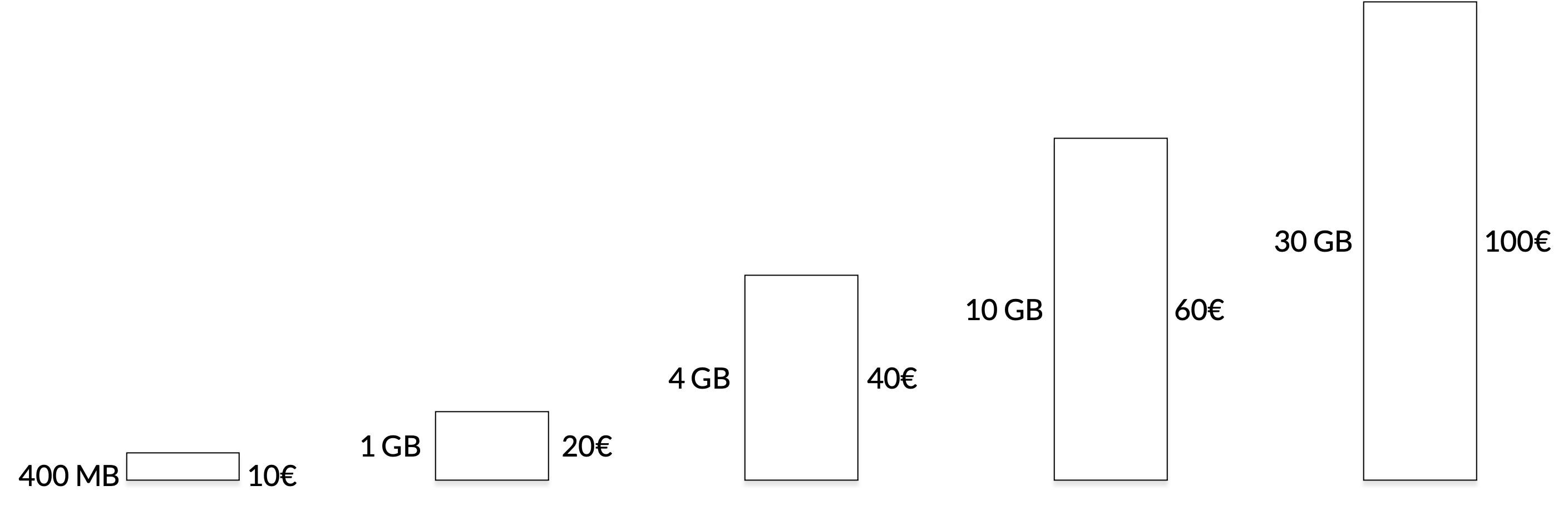
Symptoms the architects observed:
The team wanted to ride the wave of mobile data growth, raise average revenue per user (ARPU), and create a clear path to higher-value subscriptions.
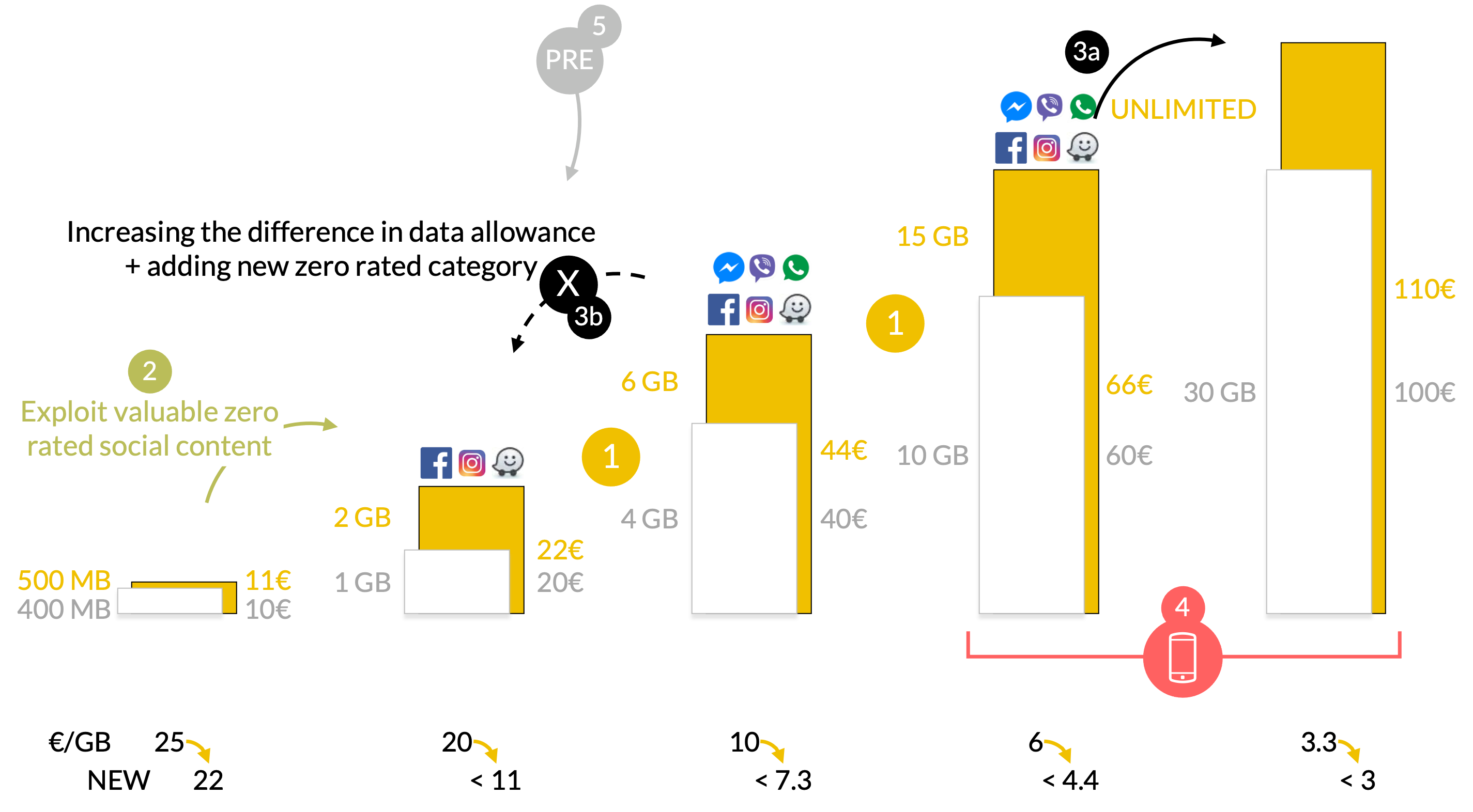
On paper the new portfolio looked simple with the similar organ pipes of tiers. In practice, this was a carefully zoned plan: more volume at better per-unit economics, targeted zero-rating as a nudging mechanism, clearer tier spacing, and subsidy reallocation to pull customers upward. Let’s break it down one by one.
This is the heart of the story, the drawing room debates and structural calculations. The team wasn’t just renaming products — they were rethinking how the building bears load, where flows happen, and how people move between floors. Below are the levers they analysed, the trade-offs they negotiated, and the logic they used to decide.
The intent was to make data feel cheaper per GB while increasing the package sizes so customers perceive clear value.
Why it matters is because perceived value opens the door to upgrades; lower unit prices make higher tiers look like better deals.
Unit-price calculations (old vs new) in the different tiers:
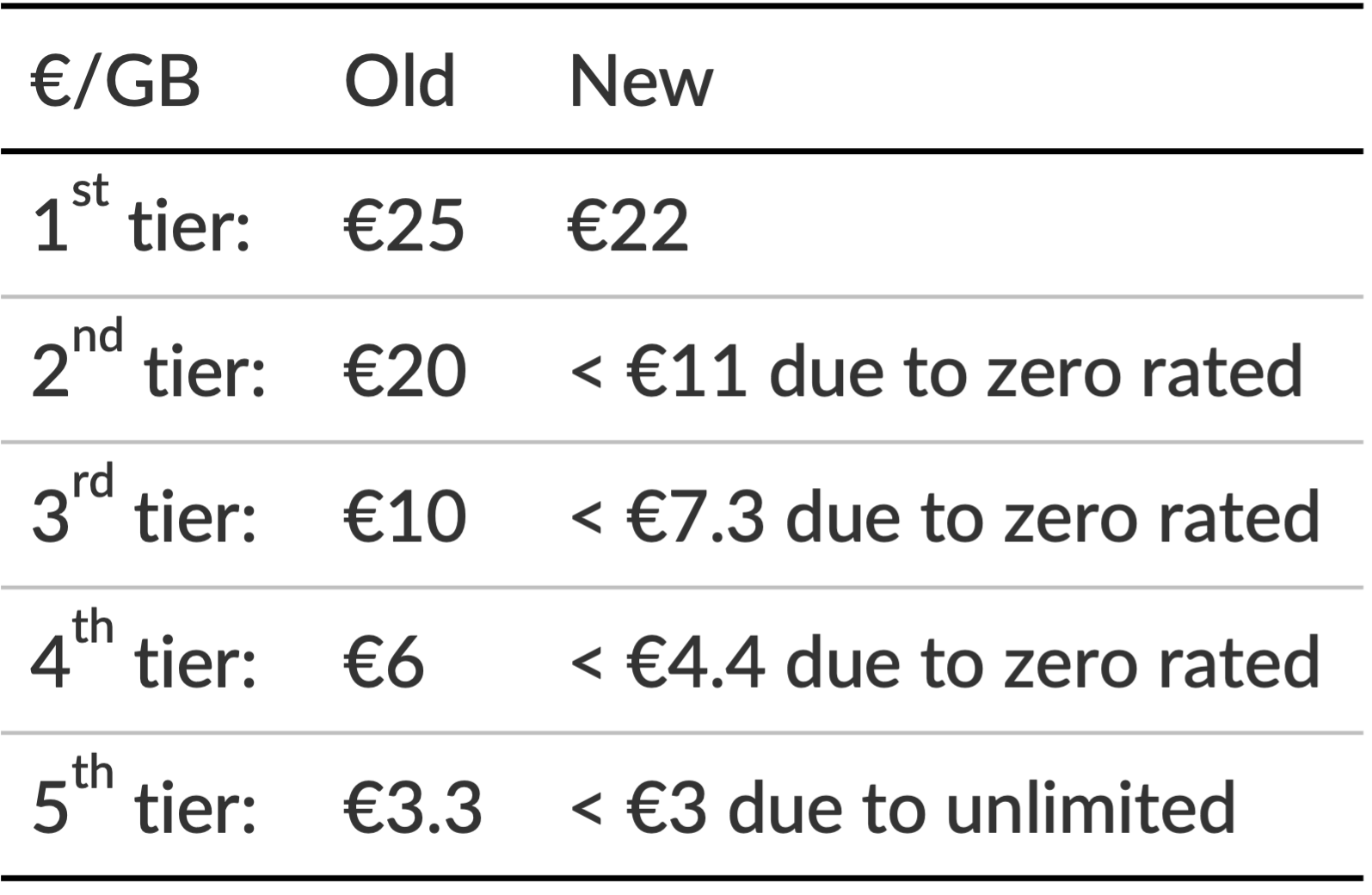
The goal was that per-GB pricing fell across comparable tiers, improving perceived value while the company captured higher absolute revenue because customers bought larger packages.
There was a problem that too many people in the cheapest tier produced low ARPU and compressed margins.
The goal was to nudge a meaningful share of entry customers to the second tier.
The team needed to make Tier 2 a clearly more attractive everyday experience — not just more GBs, but also zero-rated access to the services customers actually used (Facebook, Instagram, Waze). That made Tier 2 feel “less risky” and more convenient than the entry package.
Here is a simple illustrative impact to show why the shift mattered:
Assume we look only at the first two tiers and compare average revenue per customer there.
Old distribution within the first two tiers: 60% in Tier 1, 40% in Tier 2. Old prices: €10 and €20.
New target distribution within the first two tiers: 40% in Tier 1, 60% in Tier 2. New prices: €11 and €22.
Change in ARPU across those tiers: €3.60 which is 25.7% uplift in ARPU across the two-tier segment after the shift. This simple arithmetic shows why moving people up the second step mattered more than tiny price tweaks: the structural distribution change produces a significant ARPU boost.
The team wanted a clear, attractive end state: a “no-worries” experience that many users would aspire to.
Here is the behavioral insight behind it: people often prefer certainty. Unlimited removes the need to monitor usage — an emotional, not just rational, value. The team priced unlimited to be aspirational but reachable for heavy users. Since it is a kind of all-in proposition, it was meant to be premium.
There was also an economic trade-off: unlimited meant potentially higher marginal cost if heavy users exploded in usage. To make it viable, the team calculated expected incremental network cost per heavy user to make the network capable of handling the bigger load and cover the necessary cost increments.
A danger surfaced early: if Tier 2 included the most popular zero-rated apps and 2 GBs was enough for everyday basic usage, then former Tier 3 customers of 4 GBs could downgrade — causing revenue erosion.
As a countermeasure, Tier 3’s value proposition was strengthened — more volume (6 GBs) and additional zero-rated services (Messenger, Viber, WhatsApp). That created clear vertical separation — customers had a tangible reason to remain in (or move to) Tier 3 instead of downgrading.
Always ensure each tier is a meaningful step in value, not only in price. This prevents “ladder collapse” where tiers blur and customers slide down.
Device subsidies were reallocated toward higher tiers. That means the company accepted a higher upfront customer acquisition cost on Tier 4 and 5, expecting that customers who take a strong device subsidy commit to a higher ARPU package
For a total cost of smartphone and mobile service packages, customers could reach a better deal in this way, and the company could maximise the service revenue, which was the crucial indicator of the performance.
Prepaid users value control — they like predictability. Zero-rating gave them a taste of “worry-free” use for popular apps. Why this matters is that migrating even a fraction of low-value prepaid users to postpaid increases average recurring revenue and reduces churn volatility.
At the end it all makes sense, yet to come to this decision, the team needed to make several preparations. They modelled the migration paths from the existing portfolio to the new. They set up measurements to monitor the actual movements and defined trigger points if the performance was below or above the expectations. They were careful about network capacity: traffic forecasting informed hardware and capex decisions in parallel.
The company met all of its commercial objectives — the portfolio delivered the expected customer movement. As a result, mobile internet service revenue grew 20% year-over-year.
To make an impact on a huge customer base in a mass market, you need to